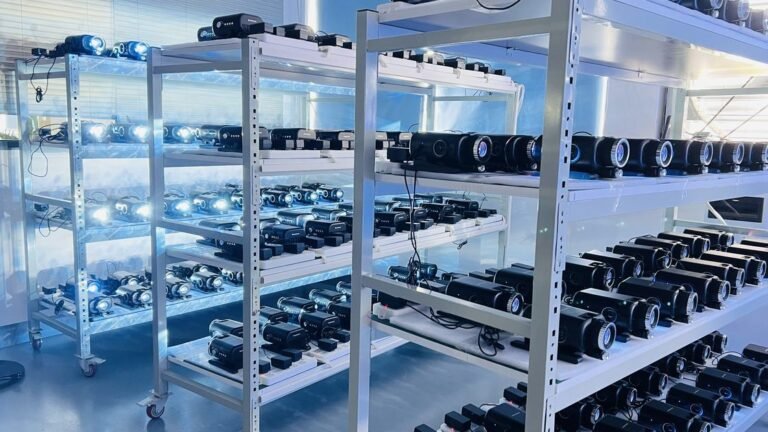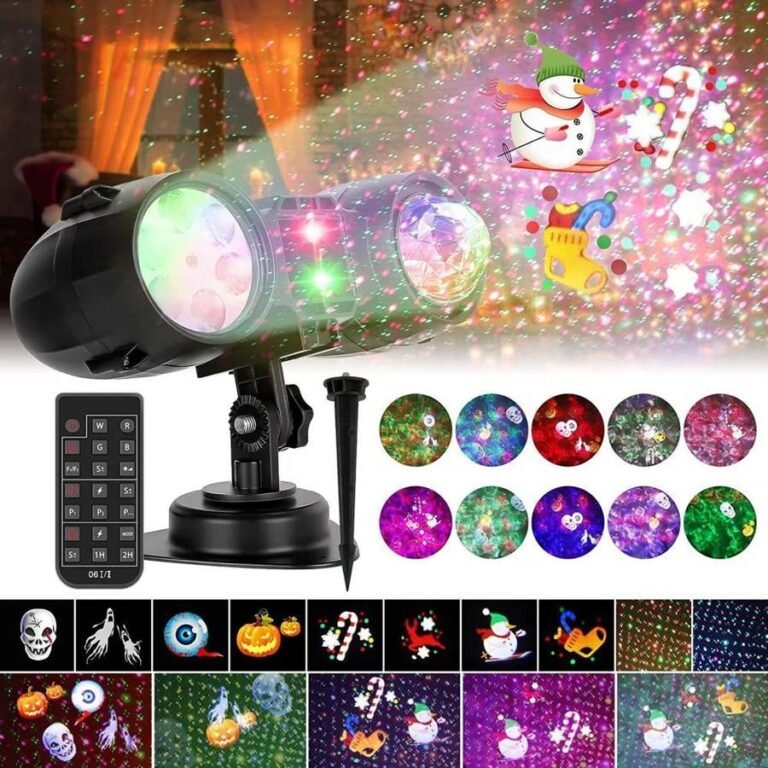

A hotel, shopping center or public plaza rarely has one lighting problem. It has rooflines to outline, trees to wrap, facades to fill, entrances to mark and open surfaces that need movement. Asking whether a holiday laser projector is “better than” light strings collapses those jobs into one comparison. The problem is not that installers are choosing the wrong technology. The problem is that a visual brief is being converted into a product choice before anyone has divided the property into design tasks.
When I receive a large-property inquiry, I do not begin with product count or labor savings. We do not have a verified US installation-cost dataset, and Bowlum does not supply strings or provide installation. I begin by marking surfaces: lines, volumes, focal motifs, background texture and areas that must remain dark. Then I ask which zones require individually placed light points and which can accept projected light from a controlled position.
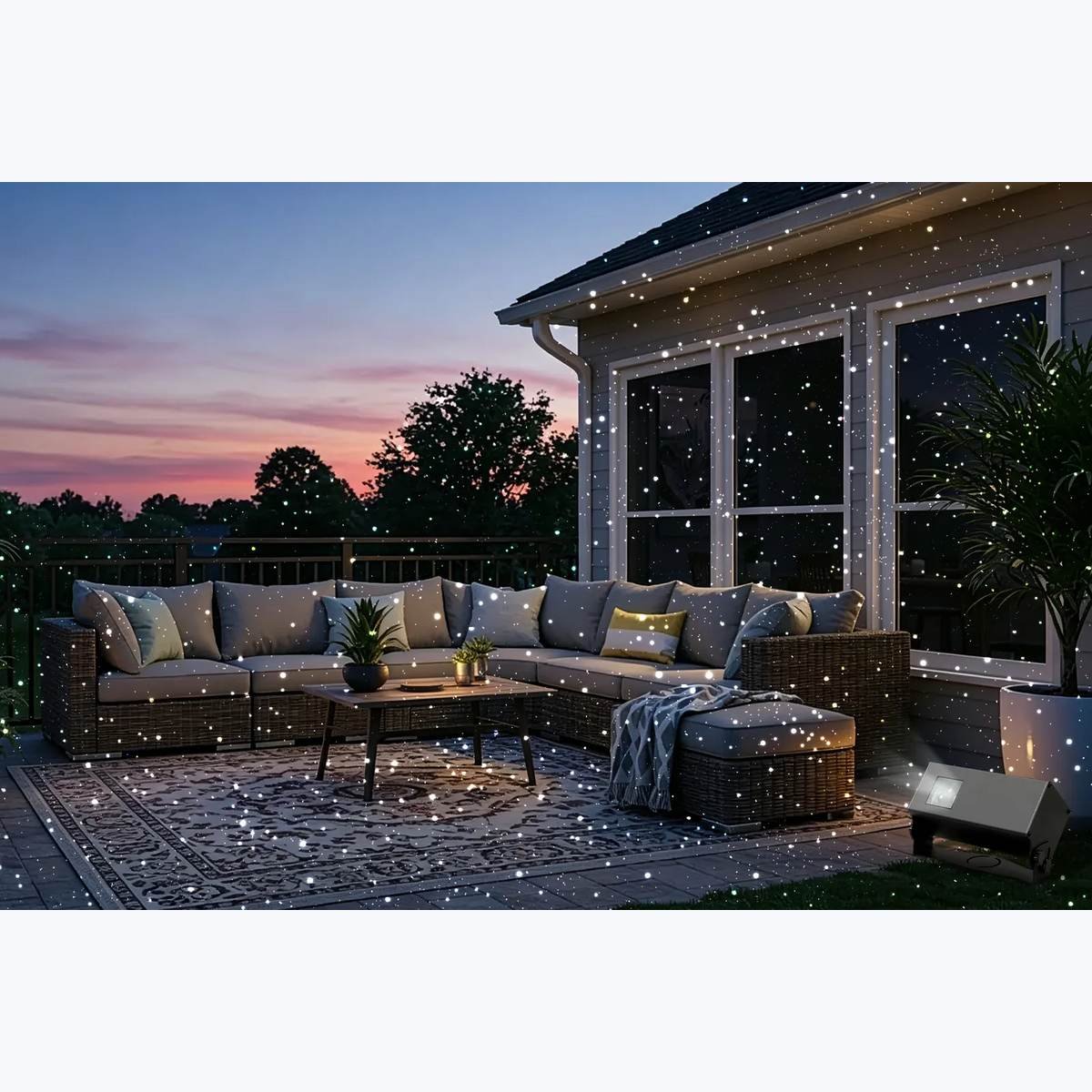
Use light strings when the design must trace a physical line or wrap a three-dimensional object. Use a holiday laser projector when a suitable surface needs broad texture, motion or repeated motifs from a controlled point. Large commercial properties often need a hybrid plan, not a winner.
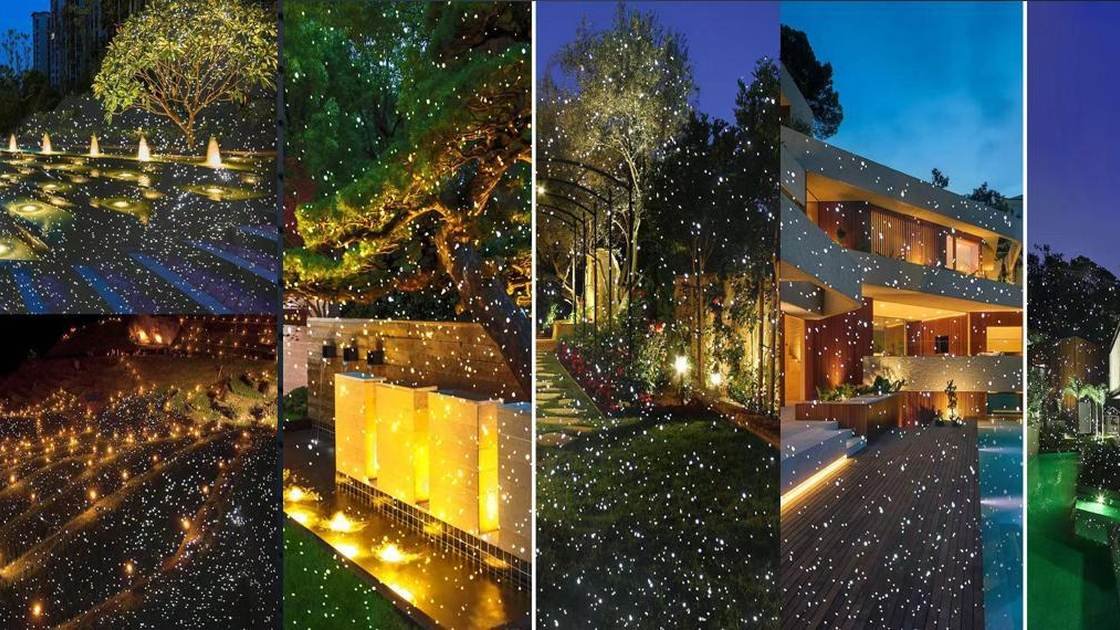
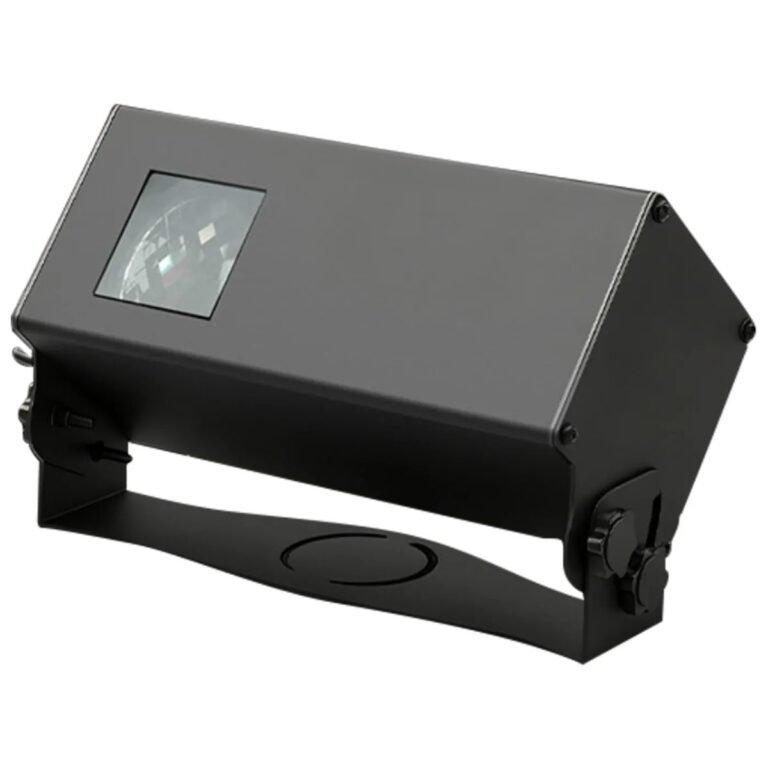
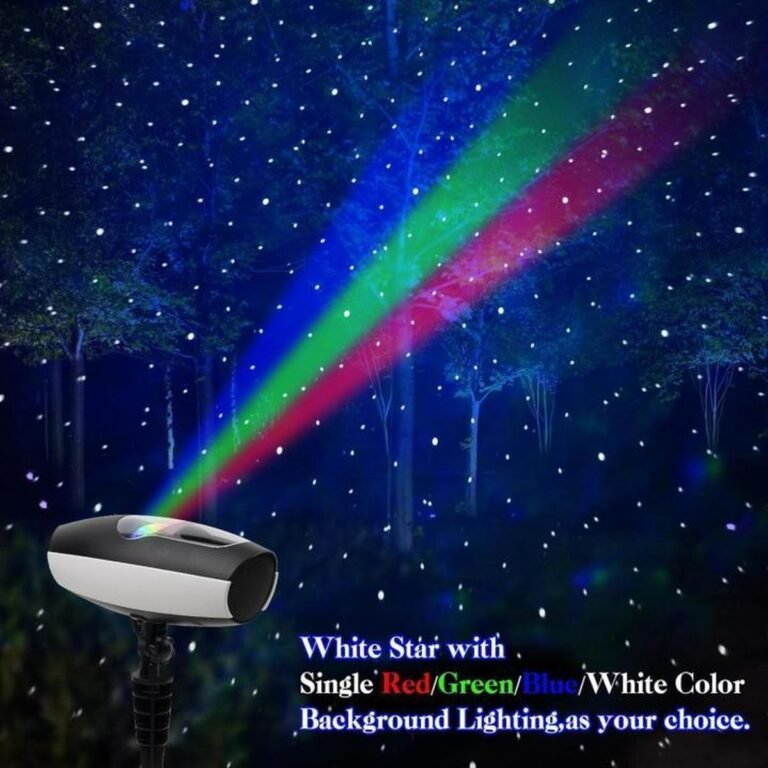
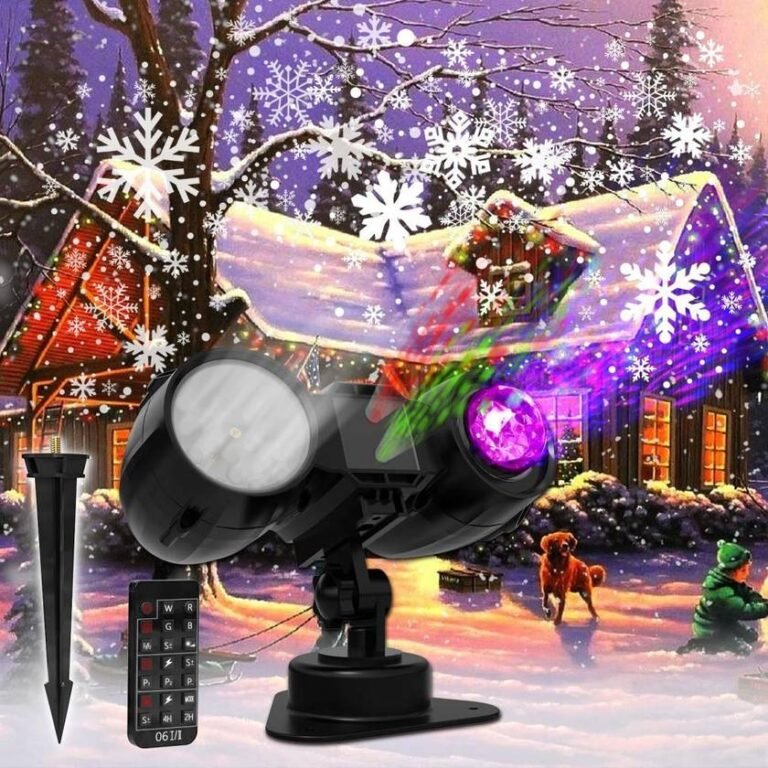
Below, I compare the two systems by geometry, weather exposure, control, safety and season planning. I use actual Bowlum model records where they exist, but I will not turn a catalog coverage range into a fixture-count promise without the building geometry and viewing conditions. Buyers can review the current outdoor projector family, compare exact models in the product catalog, and use the method here with any installer or supplier.
How Do Projection and Light Strings Organize the Same Building Differently?
Strings are installed along physical paths. Projectors are installed at positions and aimed at surfaces.1 That difference changes how the design is measured before it changes how anything is priced.
A string-light plan is primarily linear: roof edges, columns, branches and outlines. A projection plan is primarily positional and areal: projector location, throw direction, target surface, spill boundary and visible coverage. Compare the design unit first, because linear feet and projected area cannot be converted through one universal formula2.
Two Different Design Grammars
| Design task | Strings usually express it as | Projection usually expresses it as |
|---|---|---|
| Roofline or architectural edge | Length and attachment path | Poor fit unless the brief accepts texture instead of a line |
| Tree canopy | Wrapped branches or net coverage | Visible surface volume from one or more aiming positions |
| Broad blank facade | Dense installed grid or motif | Target surface, distance, angle and effect density |
| Entrance focal point | Physical motif or framed outline | Projected motif/effect with spill control |
| Open lawn | Installed elements distributed across the area | Projector position, pattern footprint and sightline |
I ask the designer to mark the non-negotiable lines first. If the client wants a roof edge to read as a crisp line from every viewing angle, strings or a physical linear system own that job. A projector cannot create a physical outline that wraps around a corner it cannot see.3
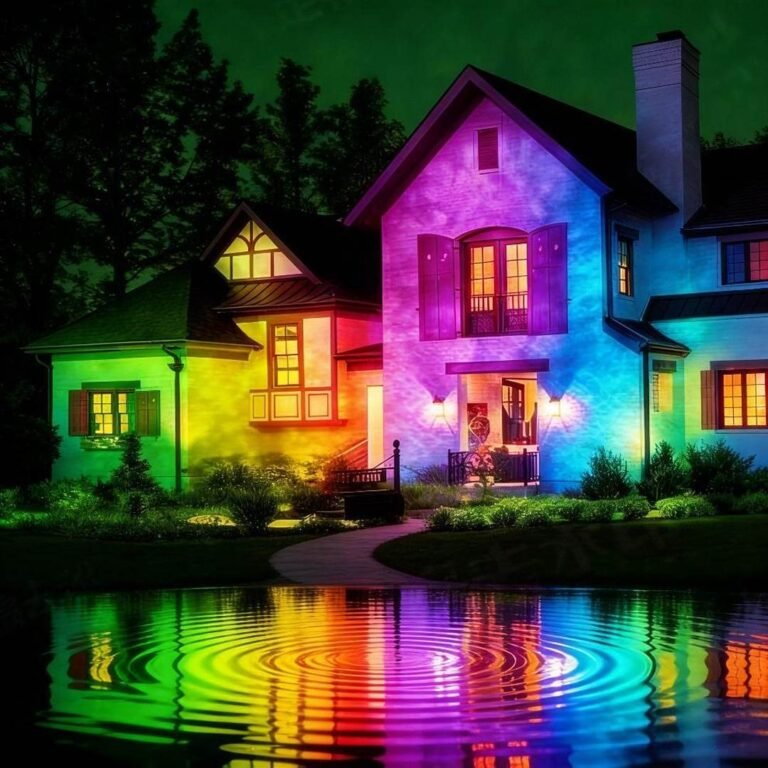
Then I mark the surfaces that can carry light: a blank wall, a canopy, a facade bay, a tree mass or a ground plane. Those are candidates for projection, provided a secure position, power path, aiming angle and acceptable spill boundary exist. This is where projection can add motion or visual density without pretending to replace the linear skeleton.
A Property-Brief Example
A commercial-property brief came to me as a simple question: “Which system is cheaper for the whole building?”4 The concept image showed a roof outline, wrapped entrance trees, a broad blank wall and a lawn where the buyer wanted movement. One technology could not reproduce every element honestly.
I redrew the brief as four zones. The outline and wrapped trees stayed with the installer’s physical lighting system. The facade and lawn became projection candidates. I then asked for viewing positions, mounting options, ambient light and areas where projected light could not appear. Only after those boundaries were visible did product selection make sense.
The buyer’s next step was to request a hybrid mockup rather than a universal cost comparison. That changed the acceptance question from “Did projection replace strings?” to “Did each zone deliver the visual job assigned to it?” Another buyer can reuse the same zone map even with different equipment and a different installer.
Do not compare technologies until the property has been divided into lines, surfaces, volumes, focal points and no-light zones.
How Do You Estimate Holiday Laser Projector Coverage on a Real Facade?
Coverage numbers look like ready-made answers, but a range without surface, angle, ambient light, viewing distance and effect-density conditions is not a fixture plan. Our own catalog contains ranges that still need those conditions.
Use catalog projection distance and area only as a screening envelope. Build the real fixture plan from the target geometry, projector position, angle, obstructions, ambient light and acceptable effect density, then verify the proposed position with the exact sample.

What the Current Records Can Confirm
BWL-OL-001, BWL-OL-002 and BWL-OL-004 each record a projection-distance range of 5–20 m and a projection-area range of 50–300 m². BWL-OL-003 records a recommended distance of about 4.9 m and an area of 50–200 m². Those are catalog-listed planning inputs. They are not a promise that one unit will satisfy every surface inside the numeric range.5
The description layer still lacks the complete measurement conditions. It does not state one shared ambient-light level, surface reflectance, aiming angle or minimum acceptable pattern density for those ranges. The products still go through production testing; the limitation is how the catalog range can be applied to a site.
Build a Position Sheet Instead of Dividing Area
| Input | Buyer records | Why a simple area division fails |
|---|---|---|
| Target geometry | Width, height, depth changes and corners | A facade is not always one flat rectangle |
| Projector position | Distance, height, angle and mounting access | Oblique angles change the visible footprint6 |
| Surface | Color, texture, reflectance and obstructions | The same output reads differently on different surfaces |
| Ambient light | Nearby signage, streetlights and interior spill | Visible density is not determined by area alone |
| Viewing zone | Main approach and sightline | A technically covered area may not read from the buyer’s viewpoint |
| No-light boundary | Roads, windows, sky and neighboring property | Spill control can determine the usable position |
I will not calculate the unit count by dividing total square meters by the top of a catalog range. That arithmetic assumes flat geometry, equal density and no overlap or obstruction. Instead, I use the range to identify candidate positions, then ask the buyer to test the exact model on a representative surface.
For a distributor preparing a project tool, the deliverable should be a position sheet: model, position, target, distance, angle, control zone, power path and acceptance photo. That sheet survives installation better than a coverage slogan.
A Practical Sample Test for the Position Sheet
Use the same unit and camera position for each candidate mounting point. Photograph the target with the projector off, then on, and record the ambient lighting that remained active. Mark the visible footprint, weak zones, obstructions and any spill outside the permitted area. The purpose is not to create a beautiful sales image; it is to preserve the conditions behind the approval.
I also ask the buyer to repeat one comparison after the surface or ambient light changes in the way the property expects during operation. A facade can look acceptable during a controlled night test and lose contrast when signage, lobby lighting or street lighting returns. That difference should change the position sheet, not be hidden by selecting only the best photograph.
If the final plan uses overlapping projectors, approve the overlap as a system. Two individually acceptable footprints can create an obvious dense band where they meet. The buyer’s acceptance image should show the combined state from the main viewing zone and identify which control scene produced it. This turns “coverage” into a repeatable installation instruction.
What Does Class 1 Mean for an Outdoor Holiday Laser Installation?
Product laser class and site installation are related but separate. Buyers sometimes treat Class 1 as permission to aim a unit anywhere; others treat the word laser as proof that no outdoor project is possible. Both positions skip the actual risk review.
Class 1 describes the accessible-emission condition of the classified product configuration7; it does not approve a mounting position, aiming direction, local permit, airspace exposure or complete site design. Verify the exact model, preserve the classified configuration and conduct a site-specific placement review.
The Model Layer
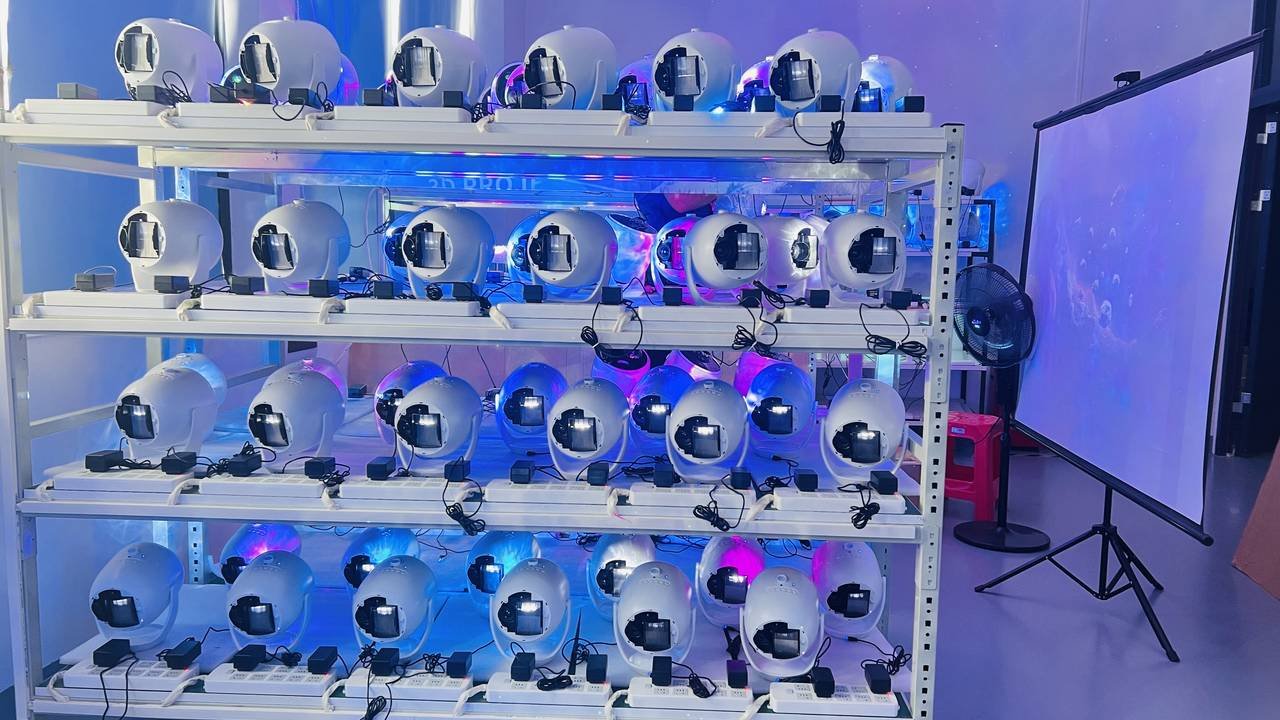
BWL-OL-001, BWL-OL-002 and BWL-OL-004 have Class 1 recorded in our catalog. At our factory, the release rule for a laser unit is Class 1, checked per unit in the in-house laser test room. This process is stronger than relying only on a batch sample, but it still needs to connect to the exact configuration a buyer selects.
I do not transfer that model wording onto BWL-OL-003 or the holiday-projector records whose model-level laser-class field is blank. Similar effects, the same factory and a shared season do not create shared evidence. For an open field, the buyer should request the exact file or keep the public claim blank.
The Site Layer
The installer or project owner must control aim, access, mounting, obstructions, movement and any local approval requirements. A Class 1 product can still be mounted badly. A safe site plan should prevent beams or patterns from entering unintended areas, keep the unit secure, and preserve the approved configuration rather than modifying optics or housing in the field.
I ask for an aiming sketch and a night review from the main viewing zone. If the plan depends on pointing above the target, across a roadway, toward windows or into uncontrolled space, product selection should pause until the placement is resolved. The product class is a gate; it is not the whole installation method.
How Should IP44 and IP65 Affect a Winter Outdoor Project?
Winter adds rain, snow, temperature cycling, condensation and handling. An IP number addresses only part of that system8, and the rating scope must stay attached to the exact model.
Use IP44 projectors only where the fixture and connections are genuinely protected from the site’s exposure.9 Use IP65 models for more exposed fixture positions, but still design drainage, adapter and connector placement, mounting and temperature evidence separately.
Model-Level Examples
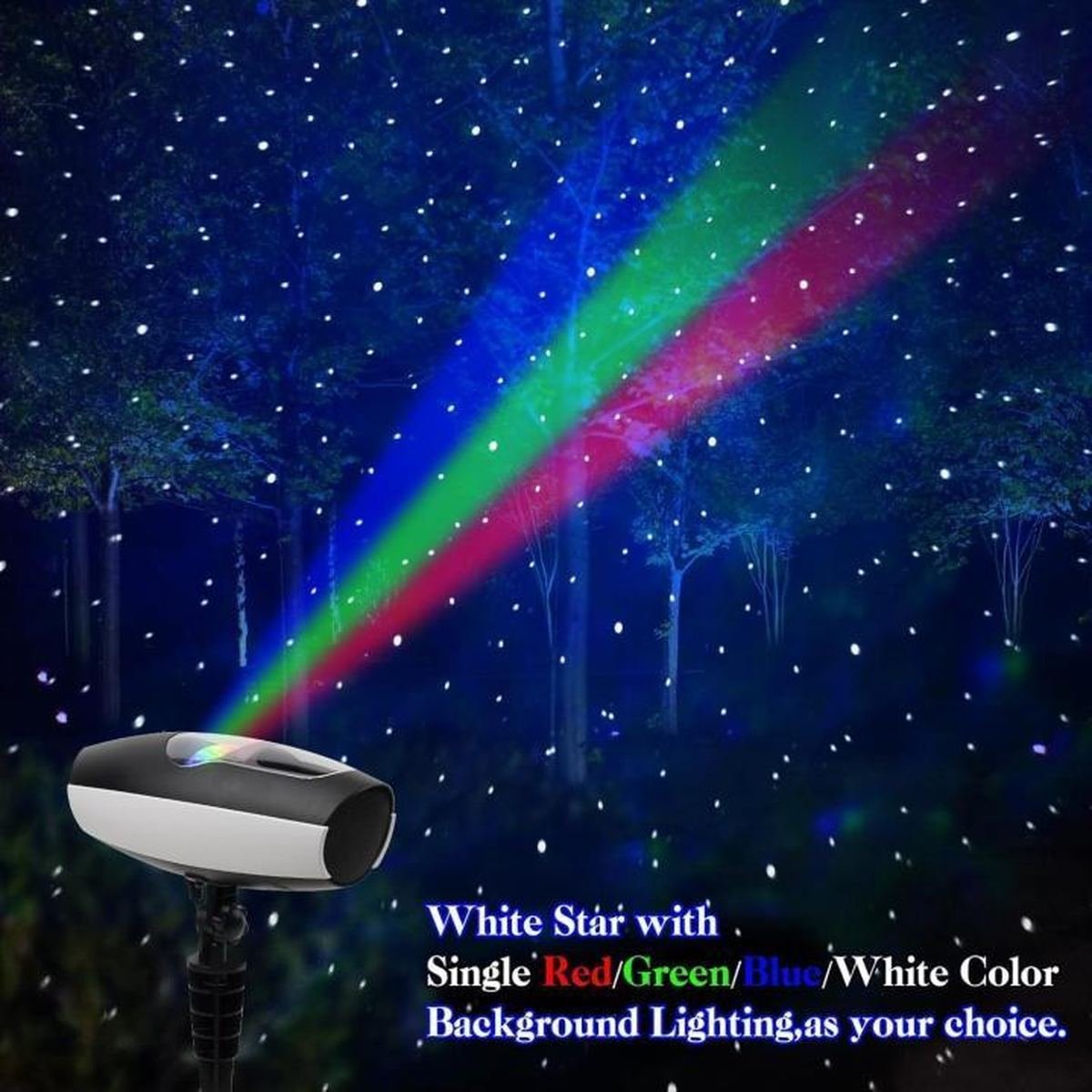
BWL-OL-002 and BWL-HP-003 are listed as IP44. BWL-OL-001, BWL-OL-003 and BWL-OL-004 are listed as IP65. That comparison helps narrow candidates. It does not allow a page to say every outdoor projector has the same protection.
I map exposure for the fixture, cable, connector and adapter as separate items. A connector sitting below the fixture can become the low point where water collects. A sheltered fixture can still have an exposed adapter. A high IP rating on the housing does not certify an extension arrangement chosen at the site.10
Weather Evidence Beyond IP
If temperature limits, UV exposure or condensation performance matter to the project, ask for the exact model evidence. Do not insert a “typical winter range.” Our current catalog does not give one complete shared temperature condition for the models in this comparison, so I leave that field open.
The buyer can still test intelligently: representative cold start, temperature transition, connector and cable review, mounting inspection and effect check under the actual ambient-light condition. The goal is not to prove the product works everywhere. It is to decide whether the selected configuration works in the named installation.
Which Commercial Projects Should Not Use Projection as the Main System?
Projection is visually efficient only when the design has a suitable surface and a controllable aiming position. It becomes a poor choice when the desired effect depends on physical lines, all-angle visibility or surfaces that cannot hold the image.
Do not make projection the main system for crisp roofline tracing, branch-by-branch wrapping, all-angle physical motifs or sites without a secure, unobstructed aiming position. Use strings or another physical lighting system for those jobs, and reserve projection for compatible surfaces and focal effects.
Start With the No List
I reject projection-first planning when the target is transparent, heavily obstructed, moving, highly reflective in the wrong direction, or visible from angles the projection cannot serve. I also reject it when the only mounting position creates unacceptable spill or public access to the unit.
A site that needs a daytime decorative object as well as a night effect may need a physical motif. A roofline that must read from both sides of a street needs installed light along that line.11 A tree whose identity comes from wrapped branches needs the wrap. These are design truths, not failures of projection.
Where a Hybrid Plan Wins
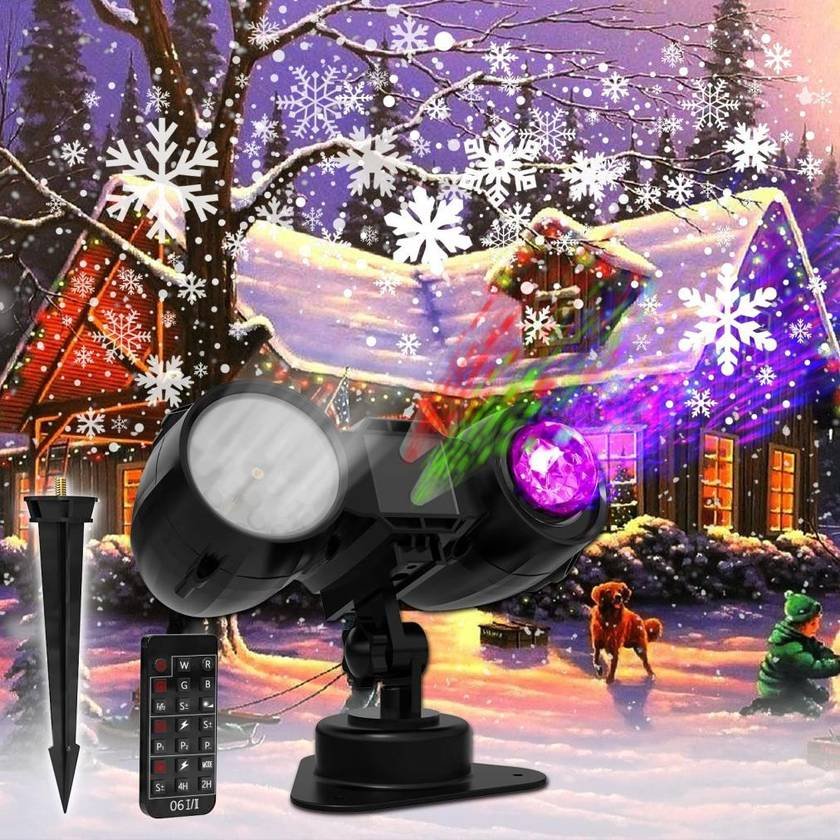
Projection can take responsibility for facade texture, moving snow, star fields, water-ripple backgrounds or broad canopy effects while strings carry edges and depth. The hybrid design also creates independent zones: the physical outline can remain stable while projection changes for dates, events or focal moments.
The acceptance plan should follow the split. Inspect line continuity and attachment for the physical system. Inspect position, surface, spill, density and control for projection. If the buyer uses one acceptance sentence for both, one of the systems will be measured badly.
A projector is valuable when it removes repetitive placement from the right surface—not when it is forced to imitate every job a physical light can do.
When Should a Commercial Buyer Place a Holiday Projector Order?
Seasonal pressure encourages a single deadline, but factory production and international delivery are different schedules. A product that completes production on time can still miss the site if freight, customs, receiving or installation preparation were treated as footnotes.
Plan backward from on-site acceptance through installation, domestic receiving, customs, freight, factory release and production. Bowlum’s standard existing-product path is about 35 days; add the actual logistics and project buffers separately instead of converting that production time into an arrival promise.
The Reverse Schedule
I ask the buyer to name the first night the system must be accepted, not the public launch date. Before that date sit installation, commissioning and a correction window. Before installation sit domestic receiving and inspection. Before receiving sit transport and customs. Before transport sit production release, aging, packing and the agreed factory path.
For an existing product or color-only program, the business-attested production path is about 35 days. Any change beyond enclosure color becomes a new-product path of about 95 days and 2,000 units or more. That distinction should be closed before artwork, advertising or installation crews are scheduled.
Do Not Promise a Month Without a Route
Our planning document prioritizes seasonal content because US buying activity rises before the holiday season, but I will not publish “order by month X” as a universal promise. The correct last order date depends on destination, route, freight mode, customs, buyer receiving and the amount of correction time the project requires.
The buyer action is to obtain a route-specific logistics plan and keep it beside the production plan. If a supplier quotes one total lead time without identifying those components, ask where production ends and delivery risk begins.
Conclusion
Holiday laser projectors and light strings are not two ways to execute the same drawing. Strings build physical lines and wrapped volumes. Projection places light onto selected surfaces from controlled positions. Once a commercial property is divided into lines, surfaces, focal points and no-light zones, the product choice becomes much clearer—and a hybrid design often becomes the honest answer.
My decision rule is to refuse the fixture-count question until I have the zone map, geometry, exposure, viewing point and control boundary. I can then test a projector against a real surface, preserve Class 1 and model-level IP evidence, and leave the installer to specify the physical system where it genuinely belongs. That sequence protects the buyer from both exaggerated savings claims and unnecessary equipment.
Frequently Asked Questions
Are holiday laser projectors better than Christmas light strings?
Neither is universally better. Strings are stronger for physical outlines and wrapped objects; projectors are stronger for compatible surfaces, broad texture, motion and repeated motifs.
How many holiday laser projectors do I need for a commercial building?
Do not calculate the count from total area alone. Record the facade geometry, projector positions, angles, surface, ambient light, viewing zones and spill boundaries, then test the exact model at a representative position.
What does Class 1 mean on an outdoor laser projector?
It describes the accessible-emission condition of the classified product configuration. It does not approve a site position, aiming direction, permit or complete installation design.
Can I use an IP44 holiday projector outdoors in winter?
It can remain a candidate in a genuinely protected position, but the fixture, connector, adapter, drainage and model-specific temperature evidence must be reviewed. IP44 is not a universal winter guarantee.
When should I choose IP65 for a holiday projector?
Choose a model-level IP65 option for more exposed fixture positions, while still handling connectors, adapters, mounting, drainage and environmental conditions separately.
Does Bowlum install commercial Christmas lighting?
No. Bowlum manufactures decorative projectors. Project owners should work with a qualified installer or contractor for site design, physical lighting, mounting and local requirements.
How long does Bowlum production take for an existing projector?
The business-attested standard existing-product path is about 35 days. Freight, customs, domestic receiving, installation and correction time must be added through a route-specific plan.
"(PDF) Architectural lighting design and aesthetics: in quest ...", https://www.academia.edu/1662254/Architectural_lighting_design_and_aesthetics_in_quest_of_theories_and_manifestoes_in_artificial_lighting_projects. A source on architectural lighting and projection mapping supports distinguishing physically installed linear lighting from projected illumination, which is planned through projector position, viewing geometry and the receiving surface. Evidence role: mechanism; source type: education. Supports: A lighting-design or projection-mapping source should support the distinction between lighting elements placed along physical geometries and projected images planned from a projector position toward a receiving surface.. Scope note: The source would establish a general design principle rather than validate the article's specific commercial-property workflow. ↩
"Projection mapping technologies: A review of current trends ...", https://pmc.ncbi.nlm.nih.gov/articles/PMC11105974/. Technical literature on projector geometry and architectural lighting supports treating installed linear length and projected surface area as different planning variables rather than as directly interchangeable measures. Evidence role: general_support; source type: research. Supports: Technical sources should support that projected footprint varies with throw distance, lens geometry and incidence angle, while string installations are measured by physical length or attachment path.. Scope note: The evidence would justify separate measurement frameworks but would not determine costs or fixture counts for a particular property. ↩
"Projection mapping technologies: A review of current trends ...", https://pmc.ncbi.nlm.nih.gov/articles/PMC11105974/. Work on projective geometry and projection mapping supports the conclusion that a projected image is constrained by the projector's line of sight and by occlusion at changes in surface geometry. Evidence role: mechanism; source type: paper. Supports: Research on projective geometry and projection mapping should support that projected content requires a visible receiving surface and cannot illuminate an occluded surface from the same projector position.. Scope note: This supports the optical constraint, not the article's broader aesthetic judgment about when strings are preferable. ↩
"Embedding Generative AI into Systems Analysis and ...", https://arxiv.org/html/2511.17515v1. Evidence from construction-cost estimating and lighting-design methodology supports defining the functional scope and site conditions before comparing the costs of alternative systems. Evidence role: general_support; source type: research. Supports: Research on design scoping and cost estimation should support comparing alternatives only after they are defined against equivalent functional requirements and site conditions.. Scope note: Such evidence would support the comparison method, not prove that every commercial property requires a hybrid design. ↩
"DiffPC: Diffusion-Based Projector Photometric Compensation", https://arxiv.org/html/2606.17521v1. Research on projected-image performance supports interpreting coverage specifications in relation to brightness, throw distance, surface reflectance, ambient illumination and viewing geometry rather than as unconditional guarantees. Evidence role: mechanism; source type: research. Supports: Technical literature should support that projected-image visibility and usable coverage depend on brightness, distance, surface properties, ambient illumination and viewing geometry.. Scope note: Independent technical evidence may not use the same test conditions or definitions as the cited catalog ranges. ↩
"Projective geometry", https://en.wikipedia.org/wiki/Projective_geometry. Studies of projective geometry and projection mapping support that oblique incidence changes the projected image geometry and therefore the usable footprint on the target surface. Evidence role: mechanism; source type: paper. Supports: A paper on projective geometry or projection mapping should support that changes in incidence angle alter image geometry and can introduce keystone or other spatial distortion.. Scope note: The source would describe optical behavior; it would not establish an acceptable distortion threshold for a particular buyer. ↩
"Test Report Model Coverage: A Buyer's Reading Guide", https://bowlum.com/the-test-report-you-were-sent-may-cover-a-different-projector-model/. Laser-safety guidance from an authoritative regulatory source defines Class 1 as a classification in which accessible emissions remain within the applicable exposure limits under the specified conditions. Evidence role: definition; source type: government. Supports: An authoritative laser-safety source should define Class 1 in terms of accessible emission limits under the applicable classification conditions.. Scope note: The definition does not by itself approve a product's site placement, aiming direction or compliance with local installation requirements. ↩
"IP65 Projector Limits: Water, Lenses and Condensation - Bowlum", https://bowlum.com/ip65-outdoor-projector-condensation/. An authoritative explanation of the IP code supports that the rating specifies enclosure protection against defined solid-particle and water ingress tests, not comprehensive resistance to all winter or outdoor conditions. Evidence role: definition; source type: government. Supports: An official standard or government explanation should define IP-code scope as protection against ingress by solids and water under specified test conditions and distinguish it from temperature, condensation, UV and connection design.. Scope note: The precise scope and test interpretation depend on the applicable edition of the standard and the exact rated component. ↩
"Outdoor Decorative Projector Manufacturer - Bowlum", https://bowlum.com/outdoor-laser-projectors/. Electrical-installation guidance supports using lower ingress-protection equipment only in locations where the equipment and its connections are protected in accordance with the applicable exposure conditions. Evidence role: general_support; source type: government. Supports: Electrical-safety guidance should support assessing the rated enclosure together with exposure, connectors, adapters and the installation location rather than treating IP44 as unrestricted outdoor approval.. Scope note: The required protection level depends on local codes, product instructions and the specific environmental location. ↩
"Extension Cord Plug Lock: Secure Your Connections with ...", https://phdns.latahcountyid.gov/article/extension-cord-plug-lock-secure-your-connections-with-safety-peace-of-mind. Electrical-safety guidance supports treating the enclosure rating of a fixture as distinct from the protection and suitability of separately selected cables, connectors and adapters used in the installed assembly. Evidence role: mechanism; source type: government. Supports: Electrical-safety guidance should support that ingress protection applies to the tested or specified component and configuration, while field connections require their own suitability assessment.. Scope note: A particular product manual or certified assembly may impose more specific requirements than general guidance. ↩
"Automatic Extraction of Textured Vertical Facades from ...", https://dspace.mit.edu/bitstream/handle/1721.1/149859/MIT-LCS-TR-729.pdf?sequence=1&isAllowed=y. Research on viewpoint-dependent projection supports the conclusion that a directional projection cannot generally provide the same continuous, all-angle reading as light physically distributed along a roofline. Evidence role: mechanism; source type: paper. Supports: Research on projection mapping and viewpoint-dependent visibility should support that a projected image is constrained by the projector's direction and may not remain visible from opposing viewpoints.. Scope note: Multiple projectors or specialized optical arrangements could alter the result, so the claim is contextual rather than an absolute prohibition. ↩